
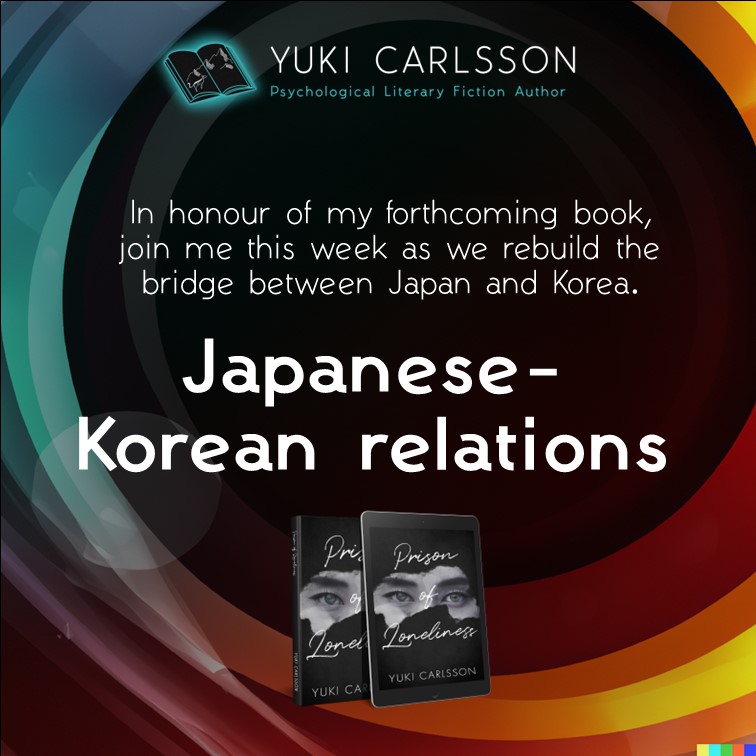
Historic shouts echo in the present. When our voices are sore, let’s tell the narratives, recount the bonds, and come to a silent understanding. This story resounds in diverse literature and my latest novel.
Read more: Japan-Korea Relations: a Tale of Shared History, Compley Dynamics, and Untapped Potential
Japan-Korean relationships from the past to the present.
Historically, Japan and Korea have shared a complex and often contentious relationship. Japan’s influence on the Korean Peninsula dates back to ancient times, with cultural and technological exchanges occurring between the two countries. However, the relationship turned more adversarial during the late 19th and early 20th centuries.
In 1910, Japan officially colonized Korea, imposing its rule and attempting to assimilate Korean culture into Japanese society. This period of Japanese colonial rule lasted until the end of World War II in 1945. During this time, Koreans faced various forms of oppression, including forced labor, cultural suppression, and language restrictions.
Following Japan’s defeat in World War II, Korea was liberated, and the Korean Peninsula was divided into two separate countries: North Korea and South Korea. Japan, meanwhile, underwent significant post-war reconstruction and transformed into a constitutional democracy.
In the post-war era, a mixture of economic ties and historical grievances has marked the relationship between Japan and Korea. Japan became an important economic partner for South Korea, providing technology, investment, and trade opportunities. This economic cooperation played a crucial role in South Korea’s rapid industrialization and economic development, known as the “Miracle on the Han River.”
However, historical issues and unresolved disputes have often strained the bilateral relationship. The legacy of Japan’s colonial rule and its handling of sensitive historical matters, such as comfort women (women forced into sexual slavery by the Japanese military during World War II) and the issue of wartime forced labor, have been points of contention between the two countries. These issues have periodically resulted in diplomatic tensions and public protests.
Today, while economic ties between Japan and South Korea remain strong, the historical and territorial disputes continue to impact their relationship. Historical issues are often intertwined with political and economic factors, influencing public sentiment in both countries. The governments of Japan and South Korea have engaged in diplomatic efforts to improve relations, but progress has been uneven and subject to changes in leadership and domestic politics.

Solutions to the prevalent tensions
It’s important to note that resolving complex diplomatic issues requires political will, mutual understanding, and sustained efforts from both sides. Here are some possible pillars to rebuild the bridge that represents the connection between Japan and Korea:
- Dialogue and Diplomacy:
Historical narratives and nationalistic sentiments deeply ingrained in the public consciousness can make it challenging to find common ground. Disagreements over historical interpretations and differing views on past events can create barriers to meaningful dialogue and reconciliation.
Encouraging open and sincere dialogue between the two governments is crucial. High-level diplomatic talks and negotiations can help address historical grievances, territorial disputes, and other contentious issues. Engaging in dialogue with a focus on mutual respect, empathy, and a willingness to find common ground can be a positive step forward. - Historical Reconciliation:
Acknowledging historical wrongs and seeking reconciliation is an important aspect of improving relations. Promoting historical education, establishing joint historical research projects, and encouraging public dialogue on sensitive historical issues can foster a deeper understanding and empathy between the two countries. - People-to-People Exchanges:
Public sentiment plays a significant role in shaping government policies and actions. Deep-rooted historical grievances, emotional attachments to national narratives, and perceptions of injustice can make it difficult to garner public support for reconciliation measures. Misunderstandings, misinformation, and a lack of awareness about the complexities of historical and political issues can further exacerbate tensions.
Promoting cultural and educational exchanges between Japan and Korea can contribute to better understanding and mutual respect. Encouraging tourism, academic collaborations, and youth exchange programs can help build bridges between the societies and promote positive interactions at the grassroots level. - Economic Cooperation:
Expanding economic cooperation and trade ties can serve as a stabilizing force in the relationship. Strengthening economic interdependence can incentivize both countries to find common ground and work towards resolving political issues. - Mediation and Third-Party Involvement: Engaging neutral third parties or international organizations as mediators can help facilitate dialogue and provide a neutral platform for dispute resolution. Organizations such as the United Nations, as well as countries with close ties to both Japan and Korea, could play a constructive role in mediating and facilitating negotiations.
- Track II Diplomacy: Encouraging non-governmental and informal channels of dialogue, known as Track II diplomacy, can provide a more relaxed and open environment for discussions. Academic conferences, expert forums, and non-governmental organizations (NGOs) can facilitate informal talks and build relationships between individuals who can contribute to resolving tensions.
- Long-Term Vision and Trust-Building: Building trust takes time and requires consistent efforts. Establishing a long-term vision for the Japan-Korea relationship, with clearly defined goals and steps towards achieving them, can help foster trust between the two countries.

The Japanese-Korean relationship in literature
I am an author, so I want to shed light on the Japan-Korea relation in literature. There are numerous books that delve into the topic from various perspectives. It’s always recommended to read multiple works and explore different viewpoints to develop a more comprehensive understanding. Here are but a few examples.
Non-fiction:
- “The Making of the Modern Korean Identity: A History, 1882-1950” by Hyung-il Pai: This book provides a comprehensive examination of Korea’s modern history and its interaction with Japan during the period of colonization.
- “Japan’s Comfort Women: Sexual Slavery and Prostitution during World War II and the US Occupation” by Yuki Tanaka and Toshiyuki Tanaka: This book delves into the controversial issue of comfort women, women forced into sexual slavery by the Japanese military during World War II.
- “Korea’s Place in the Sun: A Modern History” by Bruce Cumings: This book offers a comprehensive analysis of Korea’s history and its relationship with Japan, including the colonial period and post-war developments.
- “Contested Democracy and the Left in the Philippines After Marcos” by Nathan Gilbert Quimpo: While not specifically focused on Japan-Korea relations, this book explores the legacy of Japanese colonialism in the Philippines and its impact on democracy, shedding light on broader regional dynamics.
Fiction:
- “Pachinko” by Min Jin Lee: This novel follows a Korean family living in Japan during the 20th century, exploring themes of identity, discrimination, and the complex relationship between Korea and Japan.
- “The Guest” by Hwang Sok-yong: Set during the Korean War, this novel explores the tragic stories of Koreans forced to serve in the Japanese military and their subsequent struggles.
- “The Calligrapher’s Daughter” by Eugenia Kim: This novel tells the story of a young girl growing up during the Japanese occupation of Korea and offers insights into the interplay of personal and political dynamics.
- “Our Twisted Hero” by Yi Munyol: This novella depicts the power dynamics and struggles of a classroom during the Japanese colonial period and serves as a metaphor for Korea’s historical experience.

How my novel “Prison of Loneliness” addresses the topic.
The main character, Kigai, is a Japanese woman living abroad during the pandemics. On her escape from loneliness she virtually gets to know the Korean-American Jacob and they exchange on a daily basis. Jacob understands that it is not Kigai’s fault for what historically happened between Japan and Korea. But his family has suffered from the injustices that have happened and the deep grudge against Japan leads to recurring conflicts between the two. Where is the borderline between creating awareness and gaslighting another? Where does understanding begin and self-protection end?
Disclaimer
I created this blog post after an engaging discussion with my highly respected friend ChatGPT. The Japanese-Korean relationship is an emotionally charged and controversial topic. Even if my friend might not have feelings, I do. So please stay respectful and positive when you add further points, examples and constructive feedback in the comments.
Leave a Reply