
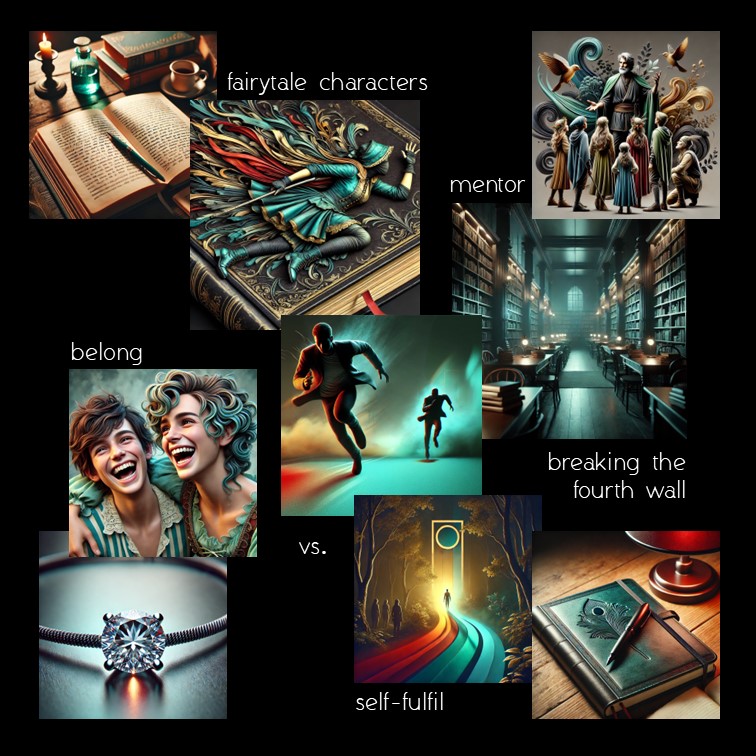
What is the deeper meaning behind the magical realism short story Your Fairytale by bestselling author Yuki Carlsson?
For that, let’s look at the sub-genre magical realism with typical tropes first. We then have a short look at the premise of Your Fairytale, before diving into the tropes and themes..
Read more: Behind the Scenes of “Your Fairytale” – Magical Realism Tropes and Their Meaning
What is Magical Realism?
Magical realism is a literary sub-genre of both literary fiction and fantasy that combines the magical with the mundane. Since Your Fairytale is more literary fiction than fantasy, let’s take a deeper look at this side of magical realism.
“It balances light-hearted fantasy elements with deeper philosophical musings, creating a narrative that is both entertaining and intellectually stimulating.” – a beta-reader of Your Fairytale
In the context of literary fiction, this sub-genre often presents deeper philosophical musings or difficult topics in a whimsical and more digestable form by adding supernatural elements to a realistic setting. Typical tropes are:
- Existential Quest: The protagonist embarks on a journey to find meaning and purpose in their life.
- Symbolic Journey: The protagonist’s journey is laden with symbolism and metaphor.
- Inner Turmoil: Deep psychological exploration of the protagonist’s fears, desires, and conflicts.
- Philosophical Musings: Characters engage in reflective and thought-provoking dialogues.
- Narrative Layers: A story within a story, or meta-narrative elements.
- Character-Driven Plot: The focus is on character development and relationships rather than action.
- Moral Ambiguity: Characters and situations are complex, with no clear right or wrong.
- Mythic Elements: Incorporation of mythological references and archetypal characters.
- Self-Reflection: Characters often engage in introspection and self-analysis.
Transformation: Psychological and emotional growth of characters, often represented through metaphor. - Intertextuality: References to other literary works, enhancing thematic depth.
Okay, so we now know what magical realism is in the context of literary fiction. But what is this short story about that I keep mentioning?

The Premise of Your Fairytale
“…captures the reader’s attention with its unique premise, making it a standout piece…” – an advanced-reader-copy (ARC) reader of Your Fairytale
Your Fairytale is a magical realism short story by Yuki Carlsson that was published 2024-08-05. It’s written in 2nd person PoV, speaking directly to the audience, and features a self-aware protagonist breaking the forth wall to venture into parallel realms on an existential journey. Here’s the full description:
Mystical messages, parallel worlds, and a dream ahead.
In a realm where you are a fairytale hero, you escape your book to embark on a self-discovery quest to write your own story. But as you step out, relentless chasers threaten your dream. You must solve challenges in parallel tales to collect clues that guide your way. After much psychological growth, a fatal message questions your entire journey. Can you write your own story or will you be trapped in a life you don’t want?
Perfect for magical realism fans of Haruki Murakami and Neil Gaiman, “Your Fairytale” by bestselling author Dr. Yuki Carlsson tells a spellbinding meta-narrative about belonging and self-fulfilment.
Get your copy today and begin your adventure.
That said, let’s look which tropes and themes the story covers.

Analysis of the Tropes and Themes in Your Fairytale
The following analysis doesn’t contain spoilers. It’s safe to read even if you haven’t read the short story, yet.

The Self-Aware Protagonist
In the story, the hero receives the revelation that they are a fairytale protagonist which serves as the initiating moment for them to start their journey. Epiphanies and relevations can have a profound impact on us. Generally, awareness is the first step to betterment.
Breaking the Forth Wall
The hero leaves their original fairytale behind with the goal to write their own story. This metaphor hints at our need to leave our habits and bubbles to reach our goals.


Self-Discovery Journey
The protagonist is on a quest to self-fulfill. For that they need to learn about themselves, about others, and develop. It’s the same for us. We need to look inside us and outside, left and right, so we can collect and combine the puzzle pieces to a greater image.
The Night Library
Described as a dark void with shelves of books beyond the comprehension of the protagonist. The eerie atmosphere reflects how stepping out of one’s comfort zone into a world different from what we know can feel scary.


The Chasers
The hero of the story faces the relentless pursuit by chasers of vague nature and needs to figure out what exactly is on their heels. It symbolises how our past can catch up with us even when we try to move on. Often, running away doesn’t resolve the issue.
Parallel Realms
Our protagonist enters other fairytale tomes and experiences their world. Drawing a parallel to the real world, it compares to living in a foreign country. It exists the same as our native country but follows different rules, culture, and mentality.


Mentor Figures
The protagonist meets the main characters of other fairytales and learns about comprehension, communication, and cooperation. What it means for us is that we can learn from others if we listen to their life experience. Ultimately, every journey brings a life lesson.
The Diamond Necklace
The protagonist wears a mysterious necklace that changes with every experience they make. This symbol is based on Yuki Carlsson’s Human Diamond model. It stands for our inherent value no matter the colour or cut and that our lives shape who we are.


Friendship vs. Self-Fulfilment
Both belonging and self-actualisation is important for our mental well-being. However, sometimes, it can feel as if we can only fit in if we put on a mask. The story revolves around the philosophical question whether it is possible to be part of a community while staying true to oneself.
The Notebook
The distant goal of the protagonist is to write their own dream story but they need to figure out how. It reminds me of a friend’s advice. “If you want to end your life, end your current life and start a new one.” We can make a new start as if writing on a blank paper.

Conclusion
“whimsical yet reflective” – a beta reader
Your Fairytale is a work of literary fiction with the sub-genre magical realism, featuring a wide range of tropes. The whimsical yet reflective short story harbours deeper meaning than one can see on first glance and invites us to introspect about our own lives.
Leave a Reply